
GWN Toolkit: Mental Health & Wellness 7 Sections31 LessonsLifetime
What’s Love Got to Do with It: Mindfulness, Compassion & You
Material Originally Appeared in:
Mentor Professional Development Session: What’s Love Got to Do With it? Mindfulness, Compassion and You with Oneika Mays’
April 14, 2023
In this section, participants will:
- Learn about the history of mindfulness
- Explore the concept of mindful life
- Discuss compassion and how it relates to the collective
- Practice loving-kindness meditation
The content in this session is both a tool for you and to support the relationship you have with your mentees. When we take the time to investigate ourselves with discipline and compassion we can embrace the totality of our experience. This in turn allows us to be more connected with the world. We open ourselves up to the experiences of others and become more inclusive.
Take a few minutes to respond to the following prompts.
- How often do you check in with yourself throughout the day?
- What does the voice in your head sound like? Is it cruel? Judgemental?
- How (if at all) do you navigate the relationship with yourself and your community?
Emotional Check-In Practice
We have different layers to our bodies. The layers are: physical, emotional, thinking, energetic, and breathing. When we are distracted we become fragmented. We can’t know how we are if we don’t check in with each part of ourselves. We can’t find ourselves if we don’t look. We’re going to do a short practice that will help us get in touch with where we are, right here, right now.
This practice can be done just as you are right now. Find a seat that feels supportive (in a chair, on a sofa, or even lying down on the floor.)
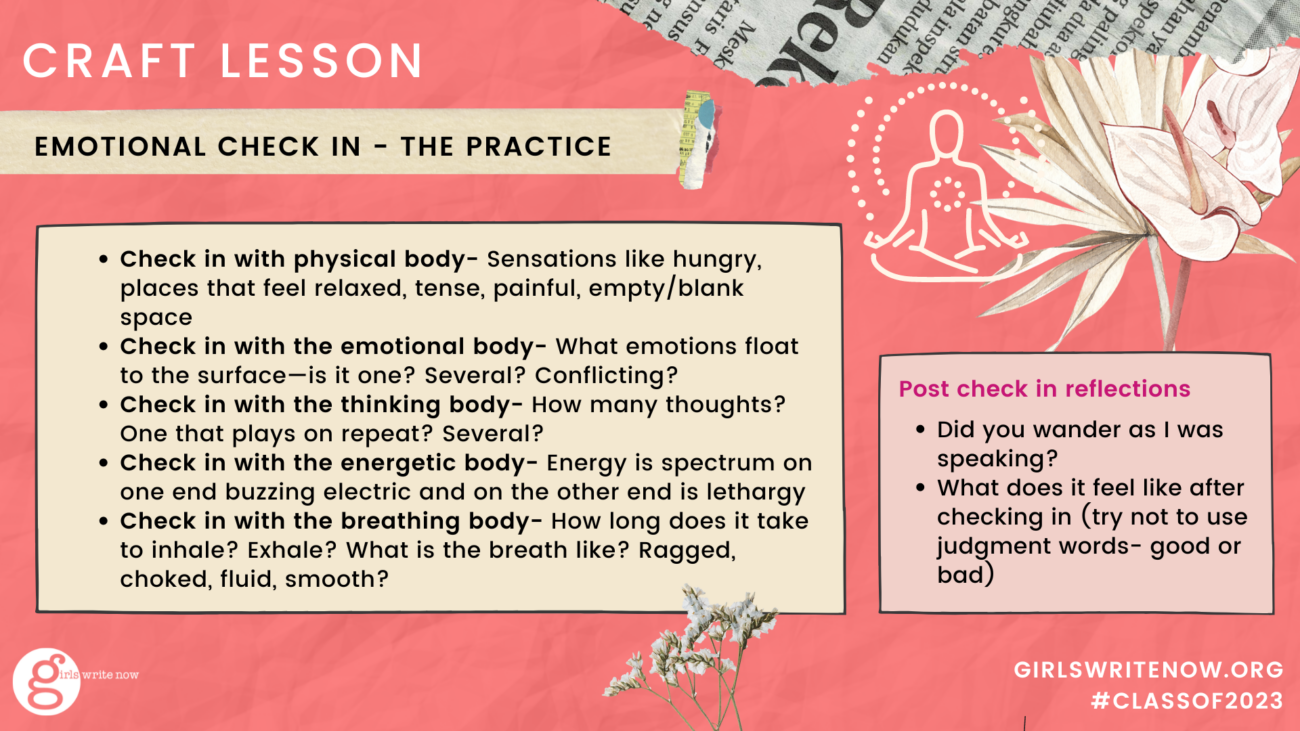
How am I right now? We’ll explore the layers without judgment (no using words like “good,” “bad” or “fine.” Instead, use descriptors).
- Check in with physical body (sensations like hunger, places that feel relaxed, tense, painful, empty/blank space)
- Check in with the emotional body (what emotions float to the surface- is it one? Several? Conflicting?)
- Check in with the thinking body (How many thoughts? One that plays on repeat? Several?)
- Check in with the energetic body (Energy is spectrum on one end buzzing electric and on the other end is lethargy)
- Check in with the breathing body (How long does it take to inhale? Exhale? What is the breath like? Ragged, choked, fluid, smooth)
Post Check In Reflections:
- Did your mind wander during the practice?
- What does it feel like after checking in? Take a few moments to reflect.
What is Mindfulness?
Elements of mindfulness include:
- Allowing what arises to be there.
- No fixing or changing.
- Talking to yourself with an air of friendliness rather than anger.
- Noticing when you aren’t present. We get stuck in the past and anxious about the future but our lives are happening in the now.
Mindfulness can be defined as paying attention in a specific way to the present moment without judgement and with compassion. The idea of doing so without judgement is key. While a byproduct of mindfulness can be a sense of feeling relaxed, that is not the main point. Mindfulness is a way to be present in the moment.
Here are a few questions to consider:
- We can respond rather than react when we are present.
- Why aren’t we present?
- How can we live mindfully?
- What activities can be done mindfully?
What is Meditation?
Meditation is a state of mental concentration. There are many meditation techniques; they generally fall into three categories:
- Insight
- Lovingkindness
- Concentration
Mindfulness can be categorized as an Insight practice.
Mindfulness vs. Meditation
- Mindfulness is a quality.
- Meditation is a practice.
- Mindfulness can be practiced formally or informally.
- Meditation is a mental exercise that trains attention and awareness.
- Mindfulness can be used in treatment that doesn’t include meditation.
- Meditation isn’t fixed but it is an exploration.
- It’s not rigid but there are rules or guidelines.
- Meditation is a practice that gives us space to live mindfully.
- With a regular sitting practice what happens ‘on the cushion’ is a dress rehearsal for real life.
Mindful movement
Mindful movement is a way of being present with your body as it moves. It’s a form of self-care that can help us improve Body Literacy, which refers to knowing how we feel inside our bodies at any given moment. Through this practice, we can get in touch with how we feel physically and emotionally, and release ‘”stuck” energy or stress.
Mindful movement can also help us to improve self regulation and interoception, which is our understanding of how we feel in any given moment. This is different from proprioception which relates to how we connect with our bodies in space.
Mindfulness can be incorporated into many activities. This is what makes it accessible and effective. Walking, dancing, free movement, and yoga can all be done with mindfulness. In fact, one can even wash dishes or do other chores with a sense of mindfulness.
Introducing “Lovingkindness” Meditation
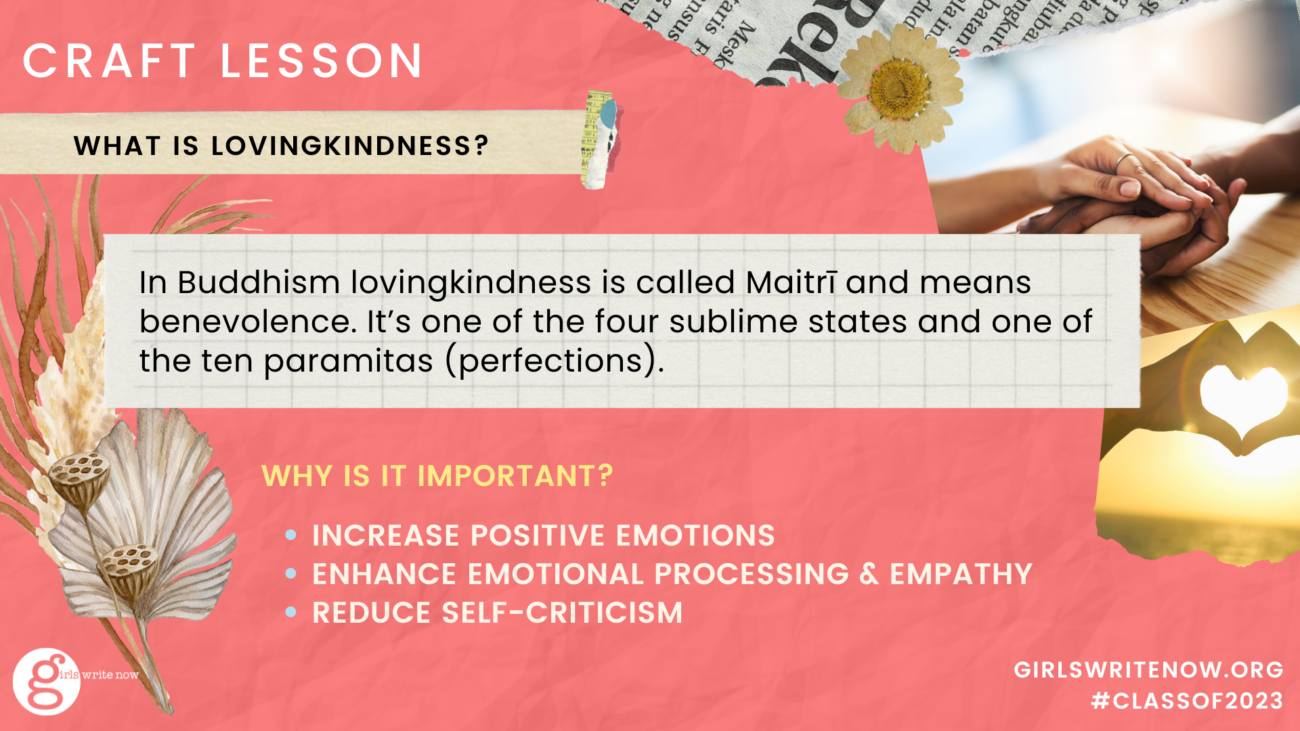
- Positive emotions naturally increase in daily life through a regular practice of loving-kindness. Loving-kindness meditation helps cultivate peaceful and pro-social emotions, according to a scientific review of over 24 studies.
- A peer-reviewed paper on loving-kindness for psychological interventions looked at how the brain changed through brain imaging.
- These studies suggested that loving-kindness may increase activation in brain areas involved in emotional processing and empathy.
- Self-criticism is a vulnerability risk factor for many psychological disorders. Loving-kindness has been shown to reduce self-criticism and increase self-compassion, especially in individuals prone to criticize.
We must define love if we are to show up for ourselves and one another authentically.
“To truly love we must learn to mix various ingredients—care, affection, recognition, respect, commitment, and trust, as well as honest and open communication.”
-Bell Hooks
Reflective Practice
As briefly introduced above, Lovingkindess Meditation also known as “Metta Meditation” has roots in Buddhism. This practice offers words of compassion to a loved one, the self, a ‘familiar stranger’ (neutral person) and a difficult person.
To begin the meditation:
- Find your posture (in a chair, on a sofa, or even the floor). If you are sitting, let the bottom of your body connect with the floor. If you are laying down, place a rolled up blanket or a pillow underneath the backs of the knees to provide additional support or comfort.)
- Grounding: Gently notice sounds that are in the distance. Bring your awareness closer. Are there sounds that are obvious? Are there sounds that are more subtle? What vibrations or sensations are present? Let the eyelids get heavy. Offer a moment of gratitude to yourself for being able to practice. Invite ancestors or guides to support your practice. Allow nature to be a source of support for the practice. Know that you are not alone. As your teacher I am resourced to hold space for you and be a support during the practice.
- Body scan: Start at the top of your body and gently work your way down. Take time to lovingly notice parts of your body that are relaxed. What parts of your body are tense? In pain? Allow whatever is ever there just to be there. There is nothing to fix or change, simply allow things to be just as they are.
Traditionally, the words of compassion offered include the following phrases:
- “May you be safe.”
- “May you be happy.”
- “May you be healthy.”
- “May your life be free of suffering.”
lovingkindess meditation for self and others
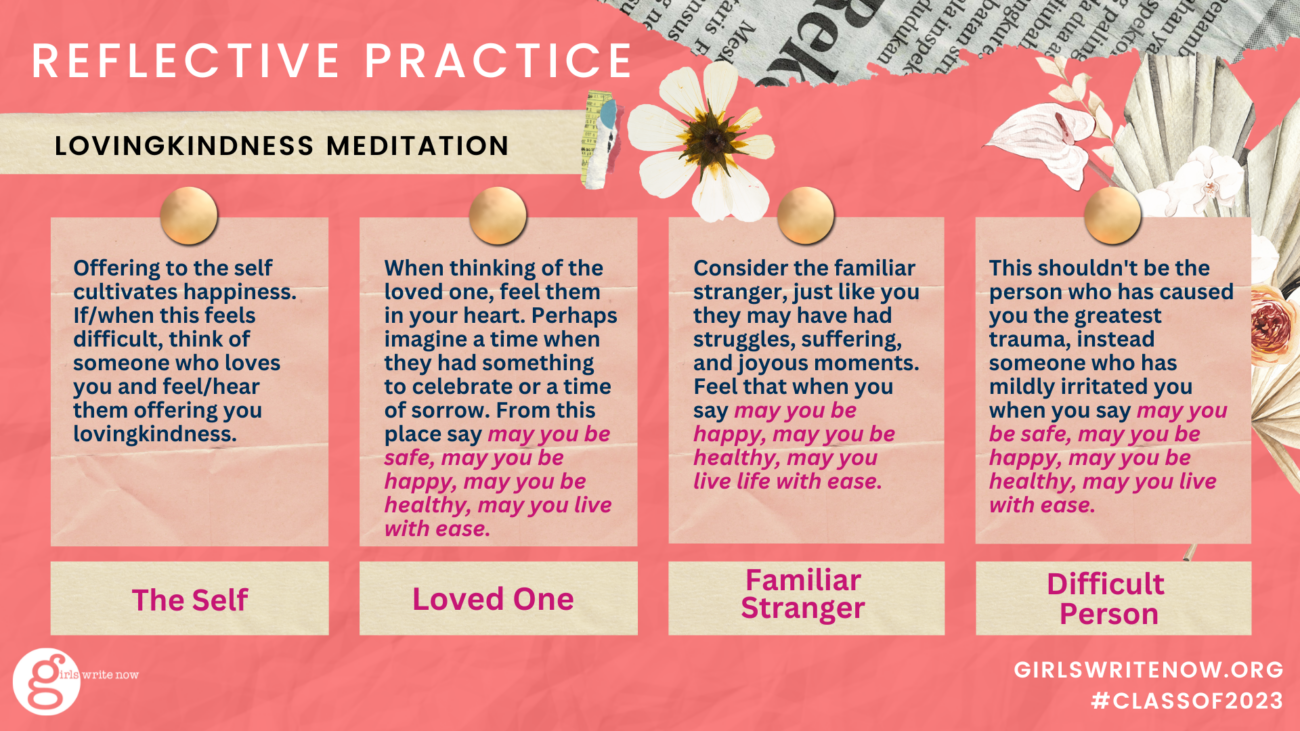
LKM For The Self:
- Take time to feel the love of your ancestors or guides to arise. Feel their love for you. Feel their love for you in your heart and body.
- Bring attention to your heart space. LKM is a heart opening practice.
- Silently and gently repeat, may I be safe, may I be happy, may I be healthy, may I be free from all suffering. Let the phrases be a gesture, an offering.
LKM For The Loved One
- When thinking of the loved one, feel them in your heart. Perhaps imagine a time when they had something to celebrate or a time of sorrow. From this place say may you be safe, may you be happy may you be healthy, may you live with ease.
LKM For The Familiar Stranger
- Consider the familiar stranger. Just like you they may have had struggles, suffering, and joyous moments. Feel that when you say, may you be happy, may you be healthy, may you live life with ease.
LKM For The Difficult Person
- This shouldn’t be the person who has caused you the greatest trauma, instead someone who has mildly irritated you when you say, may you be safe, may you be happy, may you be healthy, may you live with ease.
Compassion & Lovingkindness
Compassion can be defined as the wish for others to be free from suffering and the causes of suffering.
“True compassion means not only feeling another’s pain, but also being moved to help relieve it.”
Daniel Goleman
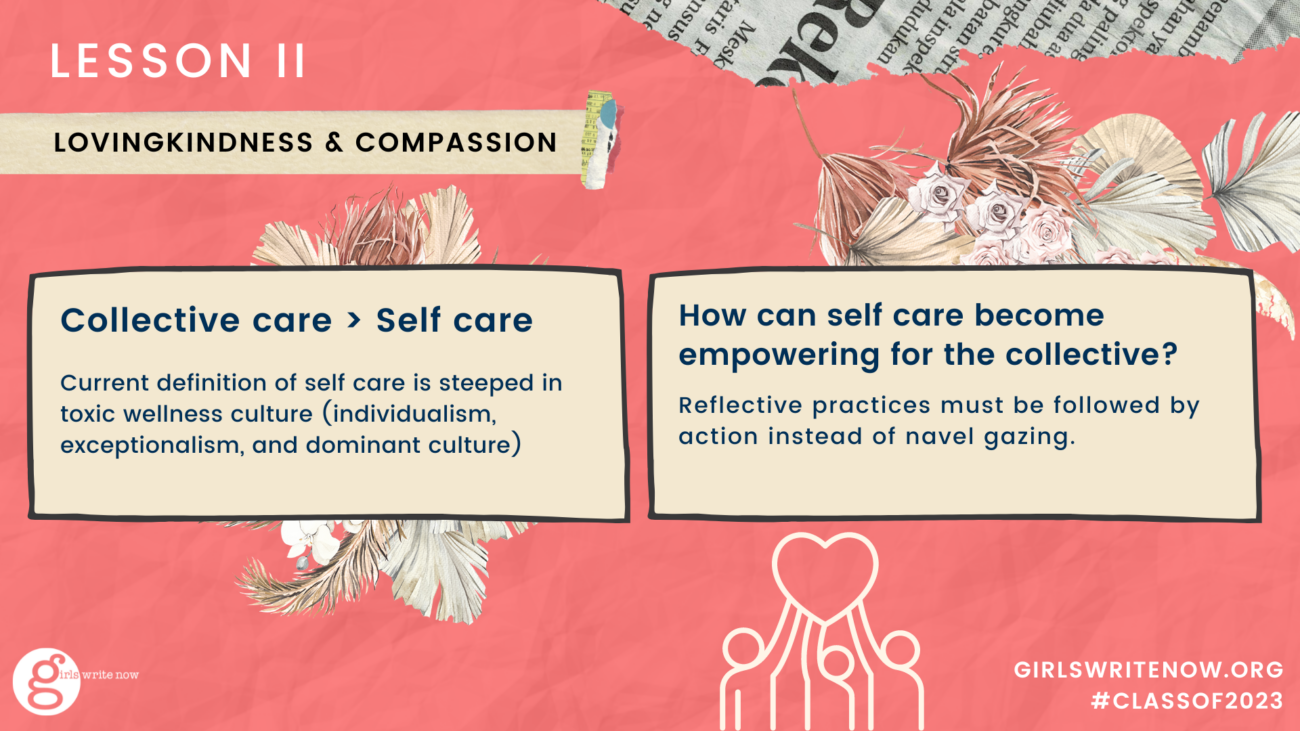
Takeaway Practice
Continue to practice on your own! Set aside some time for an emotional check in, lovingkindness meditation, or a mindfulness practice. Happy sitting!
Feel free to share this practice with your mentee!