Book of Alchemy Review
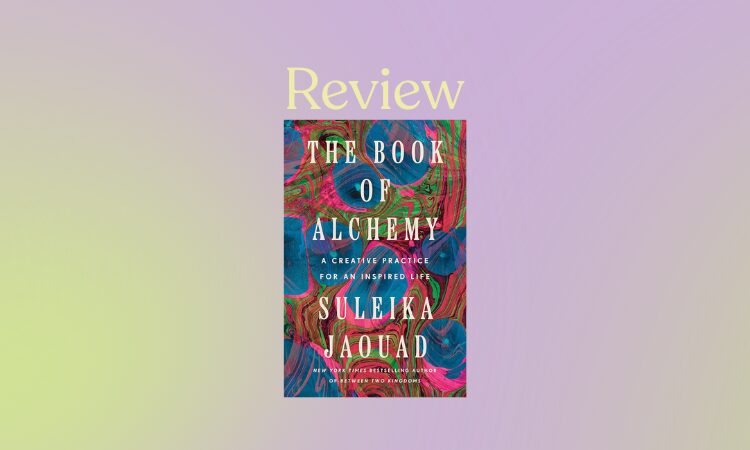

The process of “finding who we are,” Jaouad suggests, is never finished, but her prompts and methods keep the search alive in her new book.
Alchemy anticipates transformation—a shift from lead to gold, or the healing of a wound. The Book of Alchemy, by Suleika Jaouad, explores how profoundly a life can be altered by another kind of alchemy: writing.
Jaouad begins with her cancer diagnosis, a tragedy that depicts a portrayal of the body turning ill and the mind taking over. Writing offered a haven. She discovered the simple act of filling three pages a day could sustain her. She discovered through this practice that journaling could be transformative, not just as record-keeping but as a spiritual practice.
She sells the idea well. Sylvia Plath, Anne Frank, and Virginia Woolf all kept journals, and if they derived brilliance through the practice, why shouldn’t we? Her book is filled with quotes, exercises, and models we can adapt into our own lives—such as her mother’s practice of watercoloring at breakfast, which Jaouad presents as a template for integrating creativity into daily routine.
Another of her routines, one she later shared with her students, is the “100-day challenge”—committing to a single creative act every day for one hundred days. The idea edges toward self-help, but when coupled with meditations on life, a larger profoundness enters. “Genre-defying” is perhaps the most accurate description of this book, which blends memoir, workbook, and anthology. Each chapter offers a theme—fear, love, loss, joy—and pairs it with prompts that can be revisited again and again.
Curiosity about ourselves and our world fosters the humanity we risk losing. Jaouad insists on this value, embedding it in each exercise.
The structure is modular. One doesn’t need to read in order, and this sense of non linearity creates a sort of accessibility and does not intimidate the newcomer.
Guest essays appear with every prompt. Their variety gives the book range and an educational quality, though it raises a concern: Jaouad herself often appears only in the introductions and bridges. Much of the book is not her writing at all. The most impressive element may be how many writers she knows. For some readers, this enriches the perspective of the book; however, I find it to be stilted. A distance emerged between the reader and Jaouad from her lack of presence in the central points of contemplation. If what inspires the prompts is not her own, then what is her role? She effectively serves as a bridge, or organizer of ideas, yet she provides, in my view, no original insight of her own.
The questions that trouble every writer—how to be inspired, when to write, how to keep going—are answered through her prompts, which are provocative and effective. The daily writing practice or the 100-day challenge, in essence, are accessible rituals anyone can benefit from.
Of course, one could argue the book is also a business model: a marketable, polished package of inspiration designed for wide appeal. Jaouad writes with undeniable poetry, but her polish makes the product feel crafted for consumption. That said, her personal story, and her credibility as a survivor give the project a sincerity beyond its marketability.
The central message is hard to dismiss. Reflections on life, hardship, existence, and the examined self echo Socrates’ words: “The unexamined life is not worth living.” In an age of digital distraction, the act of slowing down to observe or reflect requires new urgency. Curiosity about ourselves and our world fosters the humanity we risk losing. Jaouad insists on this value, embedding it in each exercise.
Her platform makes her an effective messenger. Through her widely read COVID-era newsletter and her acclaimed memoir, she has already built an audience.
This makes the book appealing across circumstances. The prompts are pitched to anyone—whether lost, joyful, grieving, or simply restless. The process of “finding who we are,” Jaouad suggests, is never finished, but her prompts and methods keep the search alive. The practical methods she outlines—daily pages, rituals of attention, modular prompts—make the book an excellent introduction to journaling, especially for beginners who are unsure where to start.
Ultimately, The Book of Alchemy balances philosophy and pedagogy. It offers meditations on meaning while also providing a bounty of exploratory exercises.
The book’s promise is transformation. Whether you treat it as a guide, a companion, or simply a collection of essays worth dipping into, it succeeds in making journaling feel attainable and worthwhile. The included guest pieces extend its perspective. If nothing else, it will make you glance at that neglected notebook on your desk and wonder what might happen if you began again.
Process
The book inspired my review.