I Was Made to Be Big Before I Was Allowed to Be Small
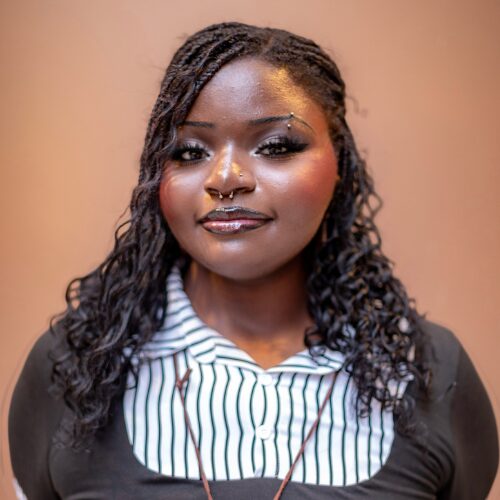
By Veony Marie Artis
Share
We are proud to present an essay by Veony Marie Artis, honorable mention in the 2025 Writing for Life Contest in the age 16-19 category.
Growing up Black, plus-size, and queer in a world that rarely leaves space for even one of those truths was not just a hardship; it was a curriculum. I learned early what it meant to be watched, to be labeled, to be handled like a problem before I could even define myself as a person. I was forced into a version of strength that had nothing to do with empowerment and everything to do with survival.
The world didn’t wait for me to grow; it handed me armor before I asked for a mirror. Before I knew what femininity felt like in my own body, it was already taken from me. My body was policed and politicized before I ever got to call it beautiful. I was made to be big—loud, strong, unbreakable—before I was allowed to be small, soft, questioning.
I grew up with four brothers and quickly became “one of them.” I wasn’t given the room to discover femininity gently. Instead, it was thrown at me like a foreign language I was expected to speak fluently. When I couldn’t, I was reduced to a tomboy. A phase. A mistaken girlhood.
But I wasn’t a tomboy. I was gender nonconforming before I had the words. I didn’t lack femininity—I just didn’t fit the narrow image of it that the world demanded. The over-masculinization of Black women and AFAB* people meant that my softness was either erased or ridiculed. I was never granted the innocence that other children were allowed to keep. There was no “cute” awkward phase for me, only assumptions, projections, and survival.
Being queer in this body—a body that others often deem too much—meant fighting for visibility even within queer spaces. When the world told me to shrink, I expanded through language. When I couldn’t speak, I wrote. Writing became the only place I didn’t need to apologize. The only place where the world didn’t touch me before I touched the page.
“When the world told me to shrink, I expanded through language.”
Writing didn’t save me—it transformed me. It gave my pain form, shape, rhythm. I began to unearth myself through poems scribbled in margins, journal entries too shaky to reread, and stories where I gave myself the happy ending. I wrote because I needed a place where I wasn’t too Black, too big, too queer. Where I was just me, unfolding line by line.
And somewhere in that unfolding, I found community. I built a queer family out of words first—people who read what I wrote and said “me too,” people who showed me that softness wasn’t a weakness, it was resistance. In a world that made me grow up fast, writing was the first place I got to come of age slowly.
There’s a quote I wrote on my wall that I return to when I forget who I am: “You are not a wound to be healed. You are a voice to be heard.” And that’s what writing reminds me. That I’m not a project or a problem. That I am someone with something to say.
As a 19-year-old, I’m still learning how to claim my space. Some days I still feel stuck in the labels the world glued to my skin. But when I write, I get to peel them off. I get to name myself, shape myself, and become someone beyond survival. Writing isn’t just an outlet—it’s a ritual, a rebellion, a return to self.
In my writing, I’ve carved out a home that never asks me to shrink. A queer home, stitched with language, lit by the glow of understanding. And in that home, I’ve found myself not as the person the world tried to mold, but as the person I’ve always been becoming.
*Assigned Female at Birth
About the Writing for Life Contest
Girls Write Now proudly joins forces with Chasing Spirits to present the inaugural “Writing for Life” Writing Prize. This award honors the free, rebellious spirit of fourteen-year-old Maya Logan Eileraas, who used the pandemic to write their novel and fought for writing as a lifeline while in foster care and mental healthcare facilities. Together, we amplify the vitality of today’s most promising young writers who use the power of their creative voices to confront the world around them.
This year, we asked girls and LGBTQIA+ writers aged 13-19 to respond to the prompt: Describe an especially difficult time you have faced, or something you have struggled to navigate, as a teenager. How has writing helped you to survive and creatively transform your experience into new understandings of self, home, and well-being?
The results were stunning reflections on mental health and the desire to find support during isolating times.
Maya's Story
About The Novel Chasing Spirits
Chasing Spirits honors the audacity and integrity of Maya Logan’s chosen path and the creative expressions that sustained them: intricate brushstrokes on canvas, poetic verses echoing their deepest thoughts, melodies strummed in solitude, and the midnight aromas of freshly baked confections.
After six months on the run from DCFS custody, hospital emergency rooms, adolescent psychiatric wards, police cars, strangers’ apartments, ambulances, and temporary shelters, Maya Logan was found unconscious in a group home in north Los Angeles.
Late one night in May 2021 during a global pandemic, fourteen-year-old Maya Logan Eileraas ran away to live with their girlfriend in Bel Air. “Nothing left to lose,” they posted on social media. Searching for their own truths around identity, home, family, world, and belonging, Maya Logan was fiercely determined to author a new life.
More than a tribute to an extraordinary teenager’s bold journey into the wild, gift for storytelling, and art of self-invention, Chasing Spirits is a stunning meditation on what it means to love, a nuanced exploration of the infinite complexity of the human psyche, and an unflinching look at a rebel heart whose light was extinguished too soon.
Centering Maya Logan’s novel, penned during the isolation of remote learning, as a testament to their profound introspection and boundless imagination, Chasing Spirits brings together investigative journalism, personal reflections, short stories, artwork, social media posts, and secret journals.