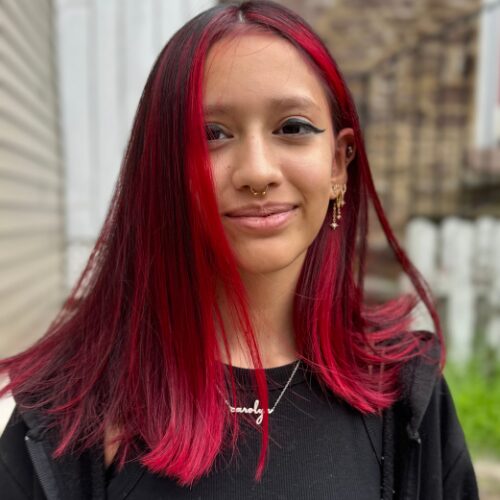
We are proud to present an essay by Saraí Pérez, honorable mention in the 2025 Writing for Life Contest in the age 16-19 category.
After bidding goodbye to the only place I have ever known—my country Venezuela—and facing the isolation of the pandemic in Colombia, I felt my identity fading.
Colombia was like confusing cumin for cinnamon in a cupcake recipe. Everything felt out of place. I was displaced to Colombia, an immigrant for the first time. My life was confined to the pages of Alejandra Pizarnik and Socrates. But basketball changed something in me; it awakened my desire to grow, to come back to life, to compete, to connect with others.
My mom didn’t want me to join the team. She complained that basketball was only for boys and that the few girls who played were definitely lesbians. A sin. Back then, there were only three girls on the team: Geraldine, Jhara, and Rolierquis, though everyone called her “La Mella.” Little did I know she would soon become the center of my world.
I have my stepfather to thank for being able to join the team. He had always wanted a son, he said. This was an opportunity to feel closer to that. And from the time I put on the uniform, I felt like I was meeting a new version of myself. My mom, however, despised seeing me in “boy clothes.” Chaos and arguments ensued at my home. But I focused only on that smile I saw reflected in the mirror. I didn’t know how to play well back then, but I had so much energy and drive. I started practicing every day at El Parque de Las Américas. I fell in love with the rhythm, the community, and the escape this provided me. On the court, I was not a displaced migrant, or someone fighting for my queerness at home, I was just me.
With time, I started to dress in loose, comfortable clothes and despite my mom calling me a “tomboy,” I felt safe. It was in fact when I wore the clothes my mom wanted me to wear that men on the streets would harass me. This new version of myself was not just about style, in becoming myself I was protecting myself from inner and outer fears I couldn’t yet speak about.
“My family told me to stay grounded and realistic, but in my poems, my dreams felt possible.”
It was in this turmoil: basketball, the first flutter of butterflies in my stomach and finding myself that I started to write poetry. Writing poetry was like finding a refuge. A neverland where I could release everything I had to keep quiet at home and on the court. In my verses, I could talk about my fears, my anger, my dreams.
MEMORIAS
No vivo lo que escribo
La paz se queda plasmada en el papel y la felicidad permanece en la tinta del pincel
No vivo lo que escribo mientras otros están guardando experiencias de su propia existencia en cajas de recuerdos y yo, yo escribo y escribo estos versos una y otras vez anhelando que algún día puedan cobrar vida.
Sería el mejor de los días.
My family told me to stay grounded and realistic, but in my poems, my dreams felt possible. Writing poetry gave me strength to continue to pursue sports and the version of myself I was most comfortable with. On the court, I had rebuilt my life and realized things weren’t always the way my mom said: my teammates weren’t lesbians just because they played basketball, and sports had no gender. Some girls, like Geraldine, also wrote poetry and danced.
And the butterflies in my stomach arrived. At fifteen, they fluttered every time I saw “La Mella” play: her curly hair, her freckles, her fury on the court. The thought tormented me. At home, that was considered abominable. My parents—deeply religious and conservative—would never accept it. How could the same people who tucked me in at night reject me? I hated myself. I cried. I hurt myself. I wondered if I was a monster. I felt trapped in another kind of isolated pandemic.
ELLA ES ARTE
La miras y te cautiva, su mente te ilumina, su cuerpo, una melodía pero su inteligencia te lleva a la trascendencia.
But I did what I knew how to do best and I found the courage to write all of this down, and in doing so, something inside me shifted. Poetry saved me. It allowed me to write without shame about the emotions that ate me up, and to come to terms with who I am judging. In poetry, my mom didn’t get to decide who I was, I was loved back, and I played fearlessly. I was free. Writing was like giving shape to my emotions like if they were clay. Through reading my own words, I understood that I am not my parents’ dreams, and that my well-being isn’t going to be determined by how much I can obey in silence. I now know I have the right to create my own dreams, to question, and to choose. In a home where that right didn’t exist, writing didn’t just help me survive; it taught me how to live and how to have a voice.
About the Writing for Life Contest
Girls Write Now proudly joins forces with Chasing Spirits to present the inaugural “Writing for Life” Writing Prize. This award honors the free, rebellious spirit of fourteen-year-old Maya Logan Eileraas, who used the pandemic to write their novel and fought for writing as a lifeline while in foster care and mental healthcare facilities. Together, we amplify the vitality of today’s most promising young writers who use the power of their creative voices to confront the world around them.
This year, we asked girls and LGBTQIA+ writers aged 13-19 to respond to the prompt: Describe an especially difficult time you have faced, or something you have struggled to navigate, as a teenager. How has writing helped you to survive and creatively transform your experience into new understandings of self, home, and well-being?
The results were stunning reflections on mental health and the desire to find support during isolating times.
Maya's Story
About The Novel Chasing Spirits
Chasing Spirits honors the audacity and integrity of Maya Logan’s chosen path and the creative expressions that sustained them: intricate brushstrokes on canvas, poetic verses echoing their deepest thoughts, melodies strummed in solitude, and the midnight aromas of freshly baked confections.
After six months on the run from DCFS custody, hospital emergency rooms, adolescent psychiatric wards, police cars, strangers’ apartments, ambulances, and temporary shelters, Maya Logan was found unconscious in a group home in north Los Angeles.
Late one night in May 2021 during a global pandemic, fourteen-year-old Maya Logan Eileraas ran away to live with their girlfriend in Bel Air. “Nothing left to lose,” they posted on social media. Searching for their own truths around identity, home, family, world, and belonging, Maya Logan was fiercely determined to author a new life.
More than a tribute to an extraordinary teenager’s bold journey into the wild, gift for storytelling, and art of self-invention, Chasing Spirits is a stunning meditation on what it means to love, a nuanced exploration of the infinite complexity of the human psyche, and an unflinching look at a rebel heart whose light was extinguished too soon.
Centering Maya Logan’s novel, penned during the isolation of remote learning, as a testament to their profound introspection and boundless imagination, Chasing Spirits brings together investigative journalism, personal reflections, short stories, artwork, social media posts, and secret journals.