Vanilla, Pandan, and Everything In Between
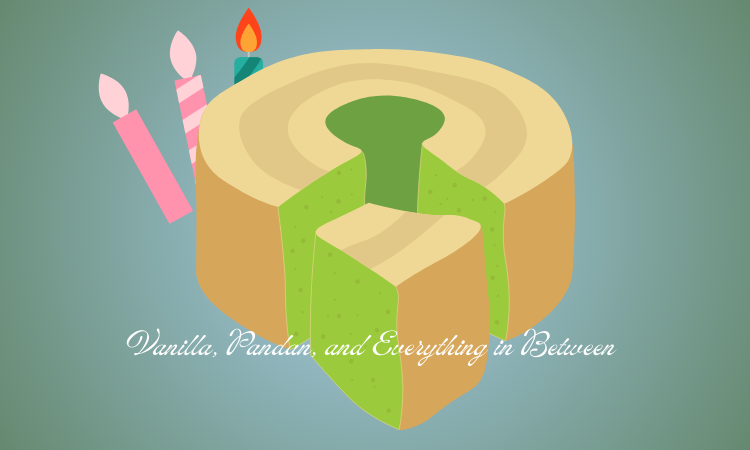

Naked without frosting, missing a slice, and tinged with a cartoonish shade of lime-green, the cake was marvelous.
I held the solitary piece to my mouth, breathing in the leafy aroma that carried hints of sweet vanilla. The soft flesh was almost too warm against my fingertips, but I was resolved to hold it for as long as necessary. To distract myself from the scalding sensation, I scrutinized the intricacy of the honeycomb texture hidden beneath the flaky brown crust.
“Eat it!” my brother urged. Bouncing in his seat, he ogled at the cake. I made him wait, glancing at Mother for her approval. Though the rest of us were in our PJs, she was still in her work dress, with her hair pulled into a rigid ponytail.
When her chin dipped forward, I sank my teeth into the sticky cake as my family erupted in raucous cheers.
In my mouth, the bite of cake melted into a sweet gummy mush, and I can’t help but grin. As I savored each bite, I realized how this familiar cake was more than a sweet treat; it was a link to my Vietnamese identity.
For a long time, I didn’t see my Vietnamese heritage as a gift. My Taiwanese and American cultures were already enough. Meanwhile, the snapshots of Vietnamese culture I had as a child—outgrown Ao Dais, traditional Vietnamese dresses, which hung in the back of my closet, and periodic conversations with my Vietnamese grandparents—were not enough. At one point, it was like my Taiwanese, American, and Vietnamese cultural identities were opposing battalions, with Vietnam losing. I was losing.
But birthdays, a day celebrated by children of all cultures, were reserved for peace. To me, the day meant one thing—cake.
Cake united all. I had grown up with vanilla sheet cake and ate fluffy Taiwanese Castella cake on my family’s frequent Chicago excursions. These were acceptable cakes. I loved acceptable cakes.
Yet, the cake in front of me was outlandish. Bánh bò nướng, a traditional Vietnamese cake composed of chewy tapioca and colored a vibrant green with pandan extract, was always a guest at Tết, the Vietnamese Lunar New Year. The alien-green cake reflected my struggles with identity—a symbol of being too bizarre to understand.
Despite all this, I still insisted on sticking my candles into its surface year after year. I was convinced eating Bánh bò nướng would alleviate the guilt of neglecting my Vietnamese side for so long. Not to mention, it tasted delicious. It took my Taiwanese mother multiple burnt trials and hours of work to get the honeycomb texture exactly right. Her dedication only fueled my determination to be the truest Vietnamese-Taiwanese-American daughter I could be. It was her constant efforts to guarantee that her children knew their Vietnamese heritage, despite the fact that it wasn’t her own, that compelled me to embrace the parts of my identity that I used to overlook.
Before I knew it, I had inhaled my first slice of cake and reached for a second, a motion that my brother promptly copied.
My mother’s lips and eyes curved upwards. “I’m surprised you guys like it,” she remarked.
Leaning back in his chair, my dad chuckled, “What can I say? They’ve inherited Vietnamese taste buds.”
I realized then that identity, like all aspects of life, is undefinable—like Bánh bò nướng, with separate ingredients fused by my experiences and shaped by my mother’s unwavering love.
It was there, at one of my birthdays, that I took in my Taiwanese mother, Vietnamese father, and my brother and me, a mix of them both and the land we were born in.
It was there, surrounded by my loved ones, when my internal battles resolved and finally, my mind had formed a united front of all three cultures.
It was there, gazing at a familiar cake, that I didn’t just see dessert; I saw myself.
Cake united all.
Process
I was inspired to write this piece after a morning that my mother and I spent baking together. I created it for my AP Lang class, but during the Explore Tour, I refined it and made it more personal than what it was in class. I also submitted this piece to the Scholastic Art and Writing awards in the personal essay section.