The Aunties
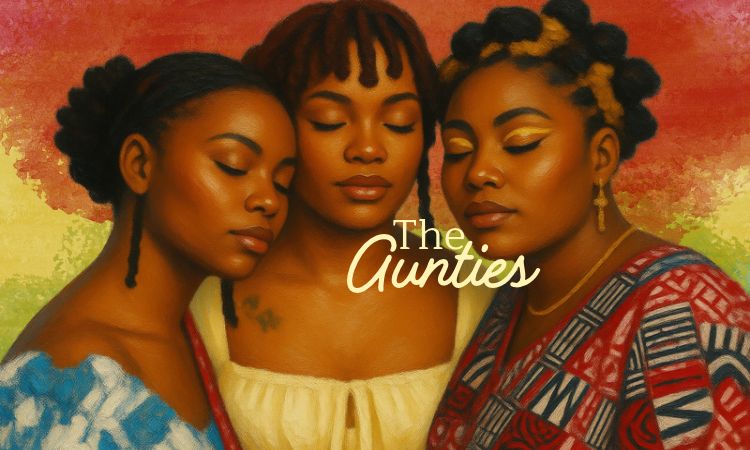

A reflective narrative piece on teenage discovery, aging, and belonging. Gratitude for the second home communal aunts provide.
When I think of the aunties, I feel a second home, not in the furniture dotting up and down the halls, but rather the wealth of love birthed in memories that leave you feeling cradled. In my formative years, a collective of aunts, regardless of blood relation, could always be found somewhere in my life story. What I didn’t understand in youth was the nurturing effort my aunts put into stitching communities together. All community events featured matriarchs juggling tasks of cleaning, cooking, packing takeaway boxes, decorating, and more while setting up the assembly line of women through breathless yells between tasks. As a child, I watched as women rushed around the space deemed the kitchen, setting up aluminum foil pans filled with food made the morning of or the night beforehand, placing them on the racks atop food burners. Women, young and old, wrapping chin-chin, bofrot, and meat pie in plastic wrap and containers. Others bumping into each other, saying “Sorry sistah,” as they handed off malts, soda, and water to the next group of women who placed the quickly yet somehow seamlessly wrapped food and drinks in propped-up gift bags waiting for their fill. After came the lines of younger women grabbing the neatly assembled bags to pass to young girls forced by their mothers to serve trays of food and hand out bags. The hustle and bustle of this semi-oiled machine worked.
Before reacclimating to this environment, everything seemed quite chaotic. Living in New York, we regularly attended the Ghanaian Methodist church on Sunday evenings. Hustle-and-bustle culture felt familiar; however, a six-year-old can only grasp a sliver of the intricacies keeping communities together and doesn’t understand how rare it is in other states. Children often view their current surroundings as constant until there is a drastic change.
Co-op City, where we resided in New York, was filled with this aura: one of aunts and uncles my parents carried a natural rapport with, while I grew accustomed to entering a room politely greeting elders and causing little disturbance to not penetrate the reverence of the adults’ homes. The Bronx Methodist church was thrice the size of our new church. High ceilings transported the melodic voices of Akan hymnals through the doors into the nearby Sunday school, where little humans dressed in button-downs with ties, floofy dresses with lacy socks and buckle shoes, kaba and slit, and ntoma sang and stomped to “Father Abraham,” following all the steps with gleeful smiles spread across our faces.
Moving to a small town in North Carolina was the largest culture shock of my short life. Pale faces surrounded us wherever we went, along with judgmental expressions, inadvertently wondering why an African immigrant family chose a town where the mall, furniture, and movie theater were the largest attractions. Keeping a cheerful, boisterous mood felt natural, so I did the same and behaved as I would in New York. Southern culture shied away from direct, overly expressive cultures. Growing accustomed to this area meant significantly toning down my language, eagerness, and enthusiasm. My new nature reflected reserved, constant silence and observation in an attempt to conform to the covert undertones of the South.
Southern conformity began to fit too well, leading to my mother’s decision for the family to regularly make the hourly drive to attend a Ghanaian church in Charlotte, a much larger city than our current residence. Upon entering the church, we looked around to find nobody there except the pastor and his wife. My sisters and I stood in the back as my mother approached to ask if the service was over. Both parties exclaimed “Eii!” in surprised excitement, before hugging warmly, which left my siblings and me turning to each other with raised eyebrows. Turns out, they knew each other from New York. Glowing smiles emitted from my mother as their connection resurfaced, as well as when the service filled with rhythmic claps, drums, upbeat praise and worship, and Akan hymnals.
While the culture felt familiar and reflected that of New York in many ways, I was practically connected to my mother’s body. Engaging with the church kids seemed futile since they echoed the natural rapport I was used to with adults. Nevertheless, frequent attendance invited aunts who urged us into Sunday school when it was time. “No” was an unacceptable answer; my eyes darted to my mother for help, but she also urged us to attend. I obliged, murmuring my disagreement for fear of receiving a stern look, otherwise known as the eye.
Although the connection was initially forced, I began impatiently awaiting the call for Sunday school to hang out with children whom I soon called friends. It was nice to share experiences with other kids who understood my plight. Whether it was our parents always having to know the other parents of kids we had sleepovers with–that is, if you were allowed–not letting us out for Halloween, or just general strictness we didn’t quite understand at the time, but later grew an appreciation for. I feel similarly about my second family, the community aunts who raised me.
**
Entering Sunday school sometimes felt akin to a daycare center. At the front, two women stood, often dressed in outfits with complex, structured shapes like layered ruffling, delicate beading, fitted ntoma clothing sewn just for them, and lovely shoes to complete the outfit. A chorus of sound greeted anyone who rounded the corridor toward the room. Inside, small children spoke at exuberant volume, and older kids sat toward the back attempting to calm the younger ones so all their eardrums wouldn’t burst.
When the aunts at the front finally spoke, quiet overtook the room. Throughout the lesson, the aunt’s speech was sprinkled with jokes and Gen-Z slang, which inevitably led to an eruption of groans, head shakes of embarrassment, and laughter. Giggles emerged from the aunts’ mouths as they laughed at their own jokes. Kids corrected them, exclaiming, “That’s not how to use that,” and “Oh my god,” to which the reply would be “Heh, don’t use the Lord’s name in vain” or “If I say it, then it’s right.” Playful banter often accompanied lessons in Sunday school, both between the leaders and among the children as we debated, conversed, and whispered throughout the room.
When the class behaved, the teenagers sulked about being paired with elementary school kids; they felt there was little to gain from simplified messages they’d heard for years on end. Sulking surprisingly became a bonding point. When we weren’t complaining about being so much older, we were laughing, discussing memes, and catching up on our day-to-day lives.
As age rests in my bones, I find myself yearning for that familiar warmth. Quippy jokes from the boys, laughing so hard my belly ached with my sisters, both blood-related and not. Dancing at parties, then having the adults mention it at the next Sunday school service, and we’d all giggle gently and nervously shrink when they attempted to pull us to dance at collection time. The way our feet cemented to the ground, outsiders may have mistaken us for statues. Our aunts would regularly call us out, saying, “So you can dance at a party, but you won’t dance for the Lord.” We’d sigh. Whatever words were finding their way out of our mouths carefully retreated as they were absolutely right.
After church ended, the congregation filed out of the two doors. This proved difficult as people stopped to speak with another member, causing traffic blocks as we exited. Once we finally arrived outdoors, people hugged while saying how long it had been since they saw each other. Aunts and uncles asked how you were doing, sometimes in English, sometimes in Twi or Fante, then asked about your family, gave their regards, and followed with reminders to listen to your parents and stay in school so you could go to a good college. The repetition of these encounters sometimes led me to make a beeline for the car, but other times, the warmth of their tone encouraged me to linger. After all, my mother was frequently pulled aside by multiple people long after the service ended.
**
While my love for the matriarchs of the community was palpable, it was also layered with complexity. Teenagers notoriously rebel against norms and conformity, and I was no exception. Balancing new identities caused me to question how I fit within the Ghanaian community, as my connection to my heritage was largely constituted by religion. Queerness was condemned within the church. Learning I was queer complicated the warmth I typically felt with the community. Hearing queer identities disparaged, then looking around to see nodding heads and exclamations of agreement fill the room, shook the foundation of my safe space. Gender also became a point of contention in my youth.
Gender was full of contradictions, complexity, and made-up ideologies. Deciphering what was Eurocentric vs. Ghanaian ideals confused me, especially since colonization influenced the latter heavily. It felt pointless to understand and silly to adhere to these mentally taxing ideas. The division of labor felt incredibly unbalanced in our culture.
Women were running around the room nonstop to alleviate the burden of work on each other. Meanwhile, the men’s feet were practically glued to the ground, aside from the occasional lifting of a package.
I always dreaded serving at events. One foot would land in the door, and the next would be on its way to help with a task. I, along with my friends, would complain to our mothers about how they had enough help, gesturing to the overflowing corridor of women. Our mothers glared at us with the eye, drenched in a do what I say and stop talking back gaze, without uttering a word. When the serving portion of the event was momentarily paused, all the girls would gather in a hallway to catch up and entertain ourselves until we were called once more. Behaving womanly meant nothing in my eyes, but, because of the women surrounding me, sisterhood meant everything.
Reflecting on that time, I realize that our annoyance with our mothers and aunts was probably the same weight as women holding the fabric of our communities together. They were simply trying to instill the message of sisterhood and shared responsibility.
Navigating self-discovery while nesting into the intimate belonging that the church community welcomed me into was challenging. Aging taught me I could simultaneously have issues with the customs and recognize the beauty within tradition. The most meaningful part of the matriarchs I grew up with was their kindness, gentleness, and care for each child in the community. Even through light chastisement and small annoyances, their love tethered us.
**
Growing up has a way of confronting the past and present. For me, this feels like navigating the grief of knowing someone, growing alongside them, to rarely seeing them because that’s just how time led us.
Consequently, the sense of common warmth is also reduced. Its presence is felt when I speak with my peers. In our eyes, the uneasy sways of our limbs fluctuate between simply greeting each other and asking slightly more intimate questions.
Belonging is a tender practice that is cultivated, especially as distance becomes more familiar than community. My appreciation for my communal matriarchs grows every day as I navigate the grief of aging. I understand now that the home I felt was a seed nurtured by decades, centuries, even of collectivist cultures. As I move into my mid-20s, the intimacy of community feels more pertinent. Love is a necessity. The burn for belonging draws my soul close. I miss the warmth home invites.
Process
This piece began as a journal entry; it is a culmination of childhood reflection, a recent community event, and a growing seed of appreciation for the communities that raised me. I gained insight from GWN community studios, courses, and recommended exercises from my mentor, Tracy Morin, to expand my imagination and strengthen the piece.